
Graphite – properties, types, composition and application
Scope of graphite, description and properties. Types of natural and artificial graphite – chemical structure, mechanical and physical characteristics.
Graphite (from other Greek γράφω – I write) is a natural material belonging to the class of native elements, an allotropic modification of carbon. It has a layered structure. Each layer of the graphite crystal lattice can be positioned differently with respect to each other, forming polytypes. Graphite finds its application in manufacturing and industrial activities.
Structure and composition of graphite
There are two modifications of a natural mineral:
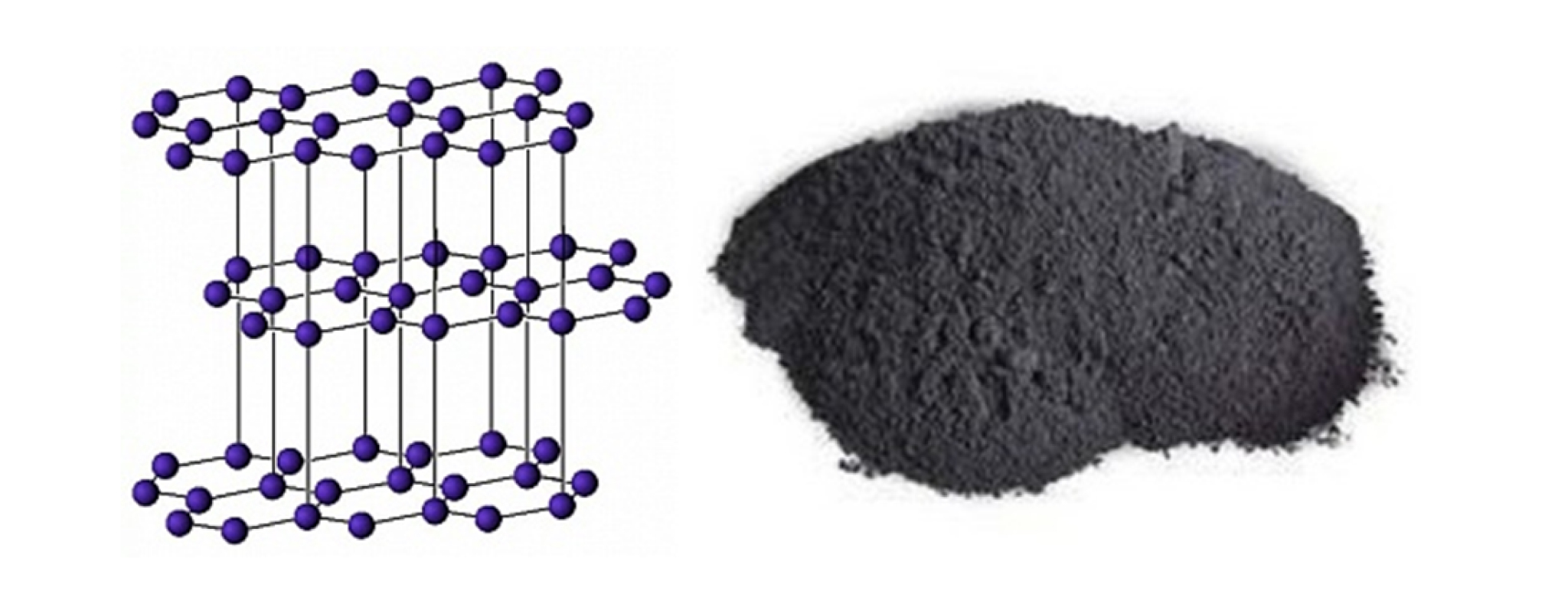
- • α-graphite (hexagonal). In this modification, half of the atoms of each of the layers are located under and above the center of the hexagon.
- • β-graphite (rhombohedral). In this modification of graphite, every fourth layer of atoms repeats the first one. In nature, it is not observed in its pure form. At temperatures from 2500 to 3300K, rhombohedral graphite completely transforms into hexagonal. Natural material is conveniently represented in hexagonal knots.
The chemical composition of graphite is not pure. In large quantities (up to 10-20%) there is ash, consisting of various components (FeO, SiO2, Al2O3, MgO, P2O5, CuO, CaO, etc.), gases (up to 2%) and bitumen, sometimes water.
The color is predominantly iron black, reaching steel gray. Has a strong metallic luster; cryptocrystalline aggregates do not shine, matte. The refractive index of graphite is Nm == l.93-2.07. Oily to the touch, leaves a mark on paper and fingers. The specific gravity of graphite is 2.09-2.23 (varies based on the degree of dispersion and the presence of the finest pores), shungite has 1.84-1.98. It has a high electrical conductivity, which is associated with a very dense arrangement of atoms in the sheets.
Graphite does not melt; if heated in a jet of oxygen, it burns harder in comparison with diamond. It evaporates only in the flame of a voltaic arc, without melting. Does not dissolve in acids. When mixed with KNO3, the powder gives a flash when heated.
Graphite in nature
In nature, it is found in granites, pyrite. It is formed in igneous and volcanic rocks, skarns and pegmatites at high temperatures, occurs in quartz veins with various materials, and is widely distributed in marble, crystalline schists, and gneisses. As a result of pyrolysis, under the influence of coal deposits of traps, large deposits of a natural mineral are formed.
Artificial graphite – scope
Structural, fine-grained, antifriction and foundry graphite is artificially produced. The scope of the material is quite wide. Graphite is used for the manufacture of refractory materials, electrical machines and installations, in the chemical, mining and manufacturing industries. It is also used to make core pencils, paints, coatings, and batteries. Graphite is irreplaceable in the nuclear industry and in other narrowly focused areas.