
Microstructure of powder alloys of the “iron-graphite” system
Powdered carbon steels are most often obtained by directly introducing carbon into the charge in the form of graphite, soot, or cast iron powder.
The microstructure of sintered iron-graphite alloys corresponds to the structure of compact carbon steels with the same carbon content. However, as a result of the uneven distribution of graphite over the volume of the mixture and the slow diffusion process, steels obtained from mechanical mixtures of powders are characterized by an uneven distribution of carbon, which leads to anomalies in the structure of the material. So, for example, in the structure of an alloy of eutectoid composition, along with the main structure of pearlite, inclusions of excess cementite (near graphite inclusions) and ferrite can occur.
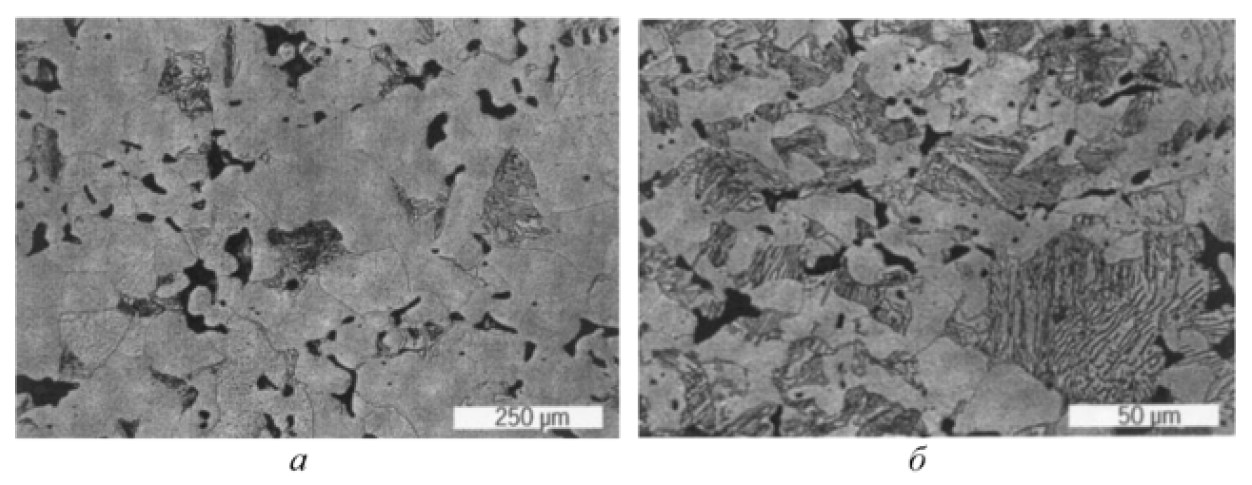
The figure shows the microstructure of powder materials with a carbon content of 0.2% (a) and 0.5% (b) obtained by pressing a mixture of atomized iron powder ASC 100.29 with graphite at a pressure of 600 MPa and sintering in endogas at a temperature of 1120 °C for 30 minutes (the density of the samples is 7.15 and 7.10 g/cm3, respectively).
Except for the presence of pores, the structures shown do not differ in any way from the structures of compact steels of the same composition.
Carbon content
Microstructure of powder alloys of the “iron-copper” and “iron-copper-graphite” systems
Copper is one of the main alloying components of powder steels, because during sintering above a temperature of 1094 ° C, melting, it forms a liquid phase and favorably affects the process of formation of the structure and properties of steel.
The maximum solubility of copper in y-iron is 8%, in n-iron – 3.5% (at a temperature of 835 ° C). Upon cooling, the solubility of copper in “-iron decreases to 0.2-0.35% at room temperature.
Slow cooling is accompanied by the release of excess copper from the solution along the grain boundaries in the form of a copper-rich e-phase. During accelerated cooling, copper remains in a supersaturated solid solution, contributing to precipitation hardening. The introduction of copper in an amount of 1.0-10 wt % increases the yield strength and tensile strength of the material, but somewhat reduces its ductility and toughness. Also, the introduction of copper significantly increases the resistance of the powder material to atmospheric corrosion. Copper reduces material shrinkage during sintering.
With the introduction of 2-3% copper, sintering occurs practically without changing the dimensions of the product, which makes it possible to avoid or significantly reduce the volume of its subsequent mechanical processing. An increase in the mass fraction of copper over 3% is accompanied by an increase in products during sintering. As a rule, copper is introduced in an amount of 1.5-4%.
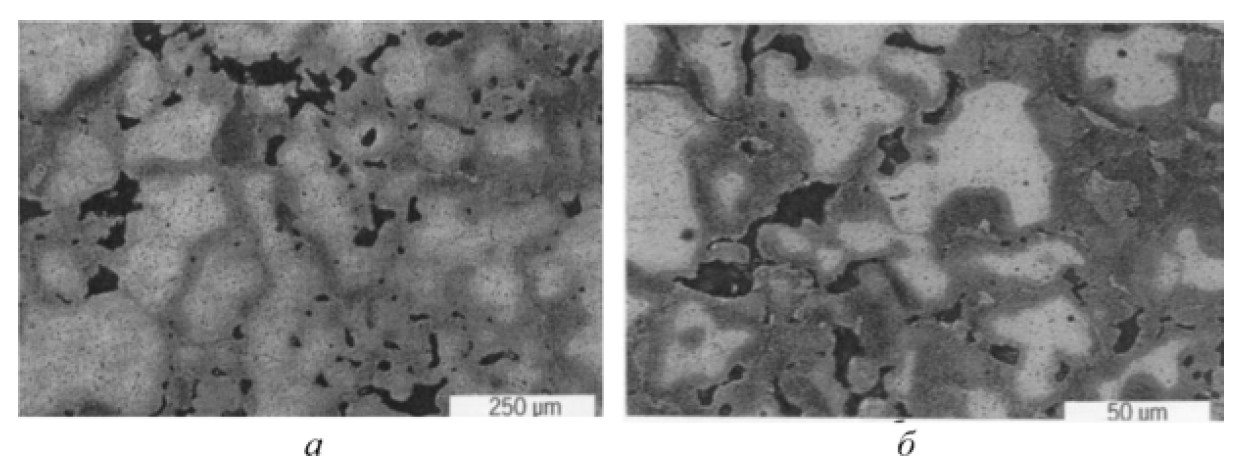
The figure shows photographs of the microstructure of alloys containings
Microstructure of powder sintered iron-copper alloys with a copper content of 2% (a) and 4% (b) It can be seen that complete homogenization of the distribution of copper in the iron matrix was not achieved during sintering (copper-rich areas have a red-brown tint after etching). With properly conducted sintering, there should be no structurally free copper in the alloys.
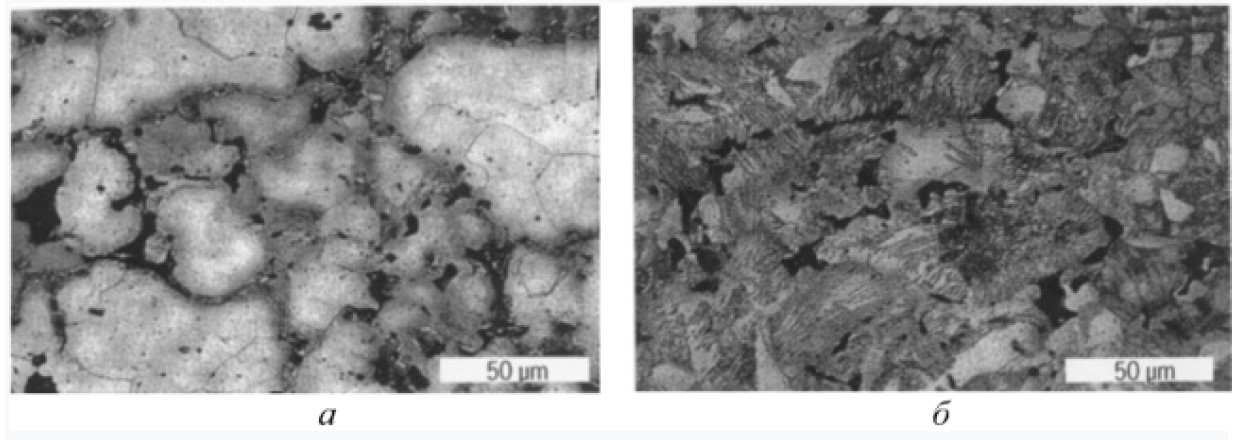
The figure shows photographs of the microstructures of materials
Microstructure of powder sintered iron-copper-graphite alloys with a carbon content of 0.2% (a) and 0.6% (b) The density of the pressed blanks was 6.9 g/cm3; sintering was carried out at a temperature of 1120°C for 30 minutes.